
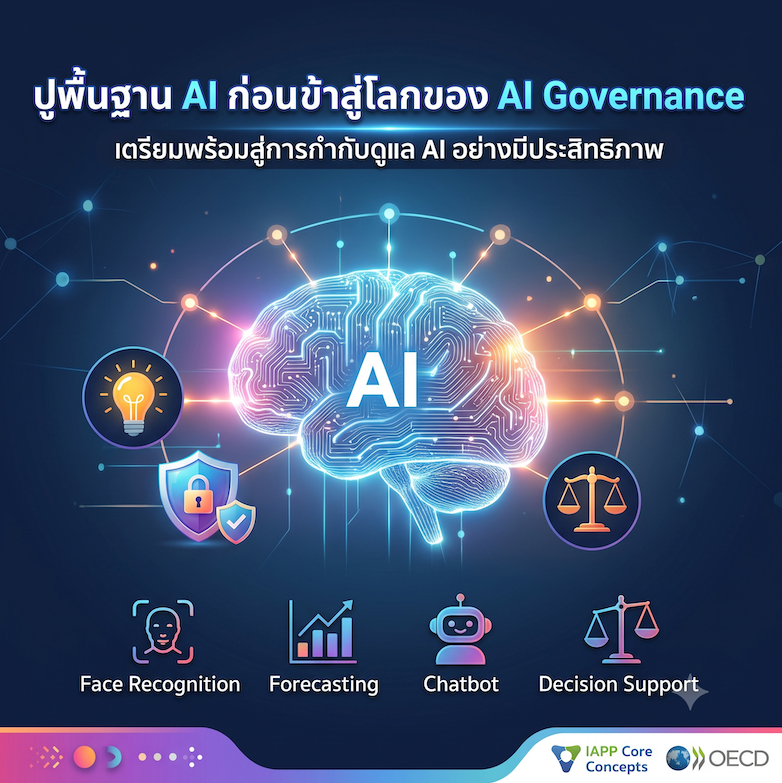
AI is a system that mimics human intelligence and spans several levels, from ANI, the kind we use every day, up to AGI and ASI, which do not exist yet. It can do everything from recognition to decision support, but its complexity, autonomy, and potential for misuse mean it needs oversight through AI Governance.
1. What Is AI?
Artificial Intelligence (AI) is a system built by humans to simulate or mimic human intelligence, enabling machines to perform tasks that normally require human intellect, such as learning, reasoning, decision making, and problem solving.
In simple terms, AI is "software that can learn from data and adapt." It is not just a program that follows fixed, pre written instructions. It can "think" and "respond" to new situations.
Key Properties of AI
- Technology: AI is built from algorithms, data structures, and computational models.
- Intelligence: AI mimics human abilities such as reasoning and problem solving.
- Autonomy: AI can operate without a human controlling every step.
- Learning: AI adapts and learns from new data or feedback it receives.
- Output generation: AI produces outputs such as predictions, classifications, decisions, and actions.
AI is not a single technology. It is a field of computer science with many applications across both business and government.
2. Types of AI: From Narrow to Broad
To understand AI Governance more fully, we need to know how many levels of AI exist and how the capabilities and risks differ at each level.
2.1 Artificial Narrow Intelligence (ANI): Narrow AI
ANI, also known as "Weak AI," is the AI we use every day. It excels at a specific task but cannot apply that knowledge to other areas.
For example, Siri or Alexa can set an alarm, play music, or report the weather forecast, but they do not understand the world the way a human does. Today, ANI is used across many industries, including healthcare, finance, manufacturing, and customer service.
2.2 Broad AI: Intermediate AI
Broad AI sits between ANI and AGI. It can perform a wider range of tasks than ANI but has not yet reached the level of AGI. A good example is a self driving car, which must combine vision, decision making, and real time responses to its environment. Another example is AI agents that carry out multi step tasks automatically.
2.3 Artificial General Intelligence (AGI): General AI
AGI, or "Strong AI," is AI with human level intelligence. It can learn and solve problems in any situation without needing special training for each task. AGI does not yet exist in the real world today, but it remains a long term goal for AI researchers.
2.4 Artificial Super Intelligence (ASI): Superhuman AI
ASI is AI with abilities that surpass humans in every area, including science, creativity, intelligence, and social skills. ASI is currently only a hypothesis, and experts believe that if AGI is successfully developed, ASI would follow.
In short: the AI we encounter in daily life is entirely ANI. ChatGPT, Siri, Netflix's recommendation engine, and Face ID are all ANI systems, each excelling at its own specific task.
3. The OECD AI Classification Framework
The OECD (Organisation for Economic Co operation and Development) developed an AI classification framework to help organizations and policymakers understand and assess the risks of AI systems in a systematic way. The framework has five main dimensions.
- People and Planet: Identifies the people and the environment that may be affected by AI, including human rights and privacy.
- Economic Context: The industries where AI is applied, such as healthcare and finance, as well as the scale and impact of its use.
- Data and Input: Where the data used to train AI comes from, how it was collected, and how it is structured.
- AI Model: The type of model, how it was built, using either machine learning or human written rules, and its intended purpose.
- Tasks and Output: What the AI does, such as recognition or forecasting, and its level of autonomy in decision making.
This OECD framework matters greatly for AI Governance because it gives everyone a shared language for discussing AI and allows risk to be assessed systematically.
4. AI and Related Technologies
AI did not emerge in a vacuum. It has grown alongside other technologies that reinforce one another. Understanding these connections helps explain why AI Governance must cover so many dimensions.
- Cloud Computing: Makes large scale processing accessible to everyone and provides the infrastructure AI depends on.
- Mobile & Social Media: Generates the massive volumes of data that feed AI learning.
- Internet of Things (IoT): Connected devices generate large amounts of data used to train AI.
- Privacy Enhancing Technologies (PETs): Technologies that protect privacy, and AI itself is also a driver pushing PETs to develop faster.
- Computer Vision, AR/VR: Helps AI see and interact with the physical world.
- Autonomous Vehicles: A clear example of Broad AI that must combine machine learning, computer vision, and edge computing.
- Autonomous Weapons: An example of AI raising ethical and global safety questions.
5. What Can AI Do?
To understand why AI Governance matters, we first need to know what AI can do and what makes it powerful enough to require oversight.
Core Capabilities of AI
- Recognition: Recognizing faces, products, voices, and text. Used in security systems, retail, and education, such as detecting plagiarism.
- Event Detection: Detecting credit card fraud, monitoring cyber threats, or even detecting goals in sports matches.
- Forecasting: Predicting sales, market demand, or weather.
- Personalization: Creating a different experience for each user, such as recommending products or content on a website.
- Interaction Support: Chatbots and virtual assistants, used in both the private sector and government, such as systems that help answer questions from student loan applicants.
- Optimization: Optimizing supply chains, planning delivery routes, or scheduling work for maximum efficiency.
- Recommendation & Decision Support: Recommending products, helping doctors diagnose illness, and helping government agencies review benefit eligibility.
Clear Benefits
- Faster and more accurate than humans at processing large volumes of data.
- Helps reduce human error and bias in repetitive tasks.
- Can process data in many forms, at high volume and high speed.
- Helps humans make better decisions, especially in complex fields such as medicine and law.
6. Why Does AI Need to Be Governed?
As AI grows more capable and embeds itself into every part of life, it brings risks that require careful oversight. The characteristics of AI that make AI Governance necessary include the following.
- Complexity & Opacity: Some types of AI are difficult to explain, since it can be hard to know why they reached a given decision.
- Autonomy: AI can operate without human approval at every step.
- Speed & Scale: Its effects can spread quickly and widely.
- Potential for Harm/Misuse: AI can create or reinforce bias and discrimination.
- Data Dependency: How good an AI system is depends on the quality of the data used to train it.
- Probabilistic Output: AI produces probabilistic results rather than a single certain answer.
The central challenge of AI Governance is striking a balance between innovation and competitiveness on one side, and the need to identify, monitor, and control risk appropriately on the other.
Conclusion: Ready for the World of AI Governance
This article has walked through the foundations of AI, covering its meaning, types, uses, and related technologies, the groundwork needed before studying AI Governance.
Once we understand what AI is, what it can do, and what risks it carries, we can understand why rules, standards, and governance frameworks are needed, spanning organizational, industry, and international legal levels.
Next Steps: Getting Ready for AI Governance
- Understand global AI legal frameworks, such as the EU AI Act.
- Study the principles of Responsible AI: transparency, fairness, and accountability.
- Learn how to assess the risk of AI systems within an organization.
- Get familiar with Privacy Enhancing Technologies (PETs) and the role AI plays in protecting personal data.
Sources: IAPP, Core Concepts of AI. OECD, AI Classification Framework.